Arts vs. Sciences: Squashing the Beef (Once and for All!)

Arts vs. Sciences: Squashing the Beef (Once and for All!)

Art
Picture of Mysha
Media Staff

When I was applying to colleges my senior year of high school, I was unsure about what I wanted to major in, as most soon-to-be college students are. One night when I was particularly stressed about this decision, I was bouncing ideas off of my older sister; when I told her that I was interested in studying English, she said, “You’re too smart for the humanities.”

Her words resonated with me. I had been writing poems and stories since I was old enough to understand words, the ways in which they connect, and the letters that comprise them, but maybe it was time to try something new—to push myself somewhere I had never really explored. And so I did. Throughout the entirety of my first year, I intended on majoring in computer science, despite the fact that I had absolutely no coding experience and, honestly, little passion for it. 

Now that it’s the end of my third semester, I have come to the conclusion that majoring in STEM—or at least computer science—is simply not for me. I don’t regret my decisions from first year, though: diving into something totally unfamiliar taught me a lot about myself and what I am passionate about. The only thing I do regret is my line of reasoning for neglecting writing. My sister’s words echoed in my head; anytime I doubted my drive to continue with programming, I reprimanded myself. I was too smart for anything unscientific. I would be wasting my talent by focusing too much on the humanities. For the better part of a year, this is how I erased myself and rewrote the narratives of my life, though the words from before always bled through anyways. 

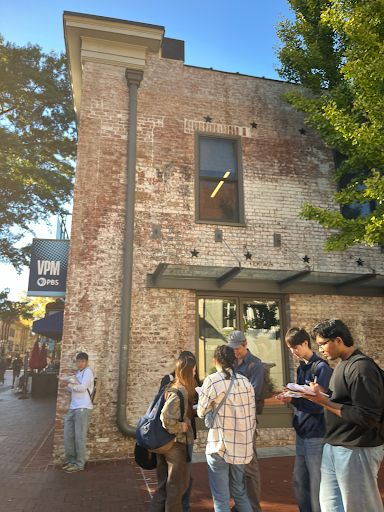
But why is this such common rhetoric? It’s not just my sister decrying the humanities and the value of studying them—scrolling through college threads on the Internet, or even just telling people that you aren’t majoring in a science, will quickly reveal the pervasiveness of this belief. This is not to say that studying the humanities is more important than studying the sciences—rather, that they are more intertwined than most people give them credit for. To gain more perspective on this, I reached out to Ashley Xiao, a good friend of mine who is studying architecture, which may be the clearest example of a major that is heavily inspired by both science and the humanities. Attached are snippets of our conversation along with photos that Ashley thought exemplified the dual nature of her studies.


How do you see the humanities and STEM overlap within architecture? What similarities have you noticed between the humanities and STEM?

Ashley: Because it is a field that requires such a rich understanding of many different subjects, most architects don’t reach the peak of their careers until later in life. I see an overlap between the humanities and STEM in architecture because a well-designed building requires a thoughtful understanding of the culture and site it is built around—requiring architects to research things like history, culture, and literature in order to respond to the needs of a client or a project. Further, art is another important element in architecture because it serves as a source of inspiration and provides the aesthetic and emotional considerations of any design.

An example of architecture

I believe that in order to be a well-rounded individual, you should have an exposure to both fields since they are equally valuable.

The humanities and STEM are similar because they both require intense dedication in order to study well. While they are seemingly completely separate from each other, I believe that in order to succeed in studying either, one needs to be highly motivated. While some consider humanities to be “easier” than STEM majors, I strongly disagree with this statement, as subjects in the humanities are difficult in their unique ways. The two studies shouldn’t be compared but rather seen as equally important. I believe that in order to be a well-rounded individual, you should have an exposure to both fields since they are equally valuable.


Do you think studying a subject heavily comprised of both humanities and STEM is more difficult than one that falls into just one category? 

Ashley: I don’t like to consider my major to be more “difficult” than any other subject because I think it’s important to recognize that any subject can be difficult in its own way. However, architecture is a challenging subject to pursue because it is incredibly tedious and requires an understanding of many different elements. A well-thought-out design takes lots of time to think through, which can make it seem more challenging in other majors. However, I don’t think it’s productive to compare it with others because every study is difficult in its own way.

One of Ashley's designs, featuring abstract pink and blue geometrical shapes.

Do you think interdisciplinary majors such as architecture offer unique benefits or challenges? 

Ashley: Yes, I believe there are both challenges and rewards that come out of studying an interdisciplinary subject like architecture. I often have trouble in the initial conceptual stages of my projects because I get overwhelmed with the possibilities of what my design can be. This can make things very overwhelming and hard to grasp, especially while working under tight deadlines. I find it easy to get overwhelmed by the potential of my projects and all the difficult outcomes that could happen. The reward I get from studying architecture is a more nuanced and thoughtful understanding of the world around me. Studying architecture has allowed me to become more open-minded and has changed the way I navigate conflict and unknown experiences in life. 

What have your interdisciplinary studies taught you? 

Ashley: My interdisciplinary studies in architecture have taught me a lot about myself and the things that motivate me to design. The more I immerse myself in architecture, the more I find myself wanting to learn more about the subject. Architecture has allowed me to be more open-minded in my understanding of the world and helped me in skills like creativity, problem-solving, and communication.

A layered example of one of Ashley's architectural studies.

So, can you be too smart for the humanities? Or STEM, for that matter? I’m inclined to give a resounding no as my answer, and I think the solution to this dilemma is a simple one: we should focus on similarities rather than differences. For example, last semester, I took both a computer science class and a literature class. To succeed in them, I had to nurture the exact same skill sets for each: critical thinking, perseverance, and curiosity. Even though one was centered on data structures and the other on literary explorations of isolation, both taught me invaluable lessons not only in their respective subjects but also in how to navigate the various challenges that life has to offer—sentiments echoed by Ashley in her studies as well. 

What you study in college is what you make of it.

This is why I believe there is no such thing as a “useless major” compared to a “good major.” What you study in college is what you make of it. To those of you unsure of what to study: if you’re passionate about something, do not try to erase that part of yourself. Our passions and interests are part of our identities, and they aren’t worth sacrificing simply for the approval of others. It can be difficult, but I implore you to tune out the world’s cries and turn inwards to make your decision.