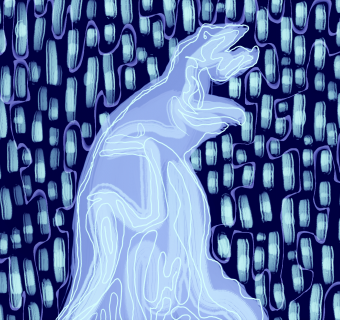
Patience sits alone in a pew for the first time. She does not look up at Parson Brim as he straightens his robes or down at the oak seat, which sags as if Prosper still sits there. Instead, she watches the sunrise filter in through the stained glass landscapes of the Garden. Each time she studies the windows, she spots a new detail—a goat with four tongues, a hornbeam with a double-helix trunk, or a wildcat with a falcon’s head. Her gaze settles on Prosper’s favorite scene, where a six-legged serpent tries to chase a bear cub across a golden pond. The cub floats, and the snake begins to sink.
She does not realize that Brim has started preaching until he stops beside her. “The Garden gives us all we need. In return, we must give the Garden what it needs. And what is that… Patience?” For a moment, she thinks he means that the Garden needs her, that the parish must give her to the Garden. Then, she realizes he is waiting for her answer.
“Devotion.”
The parson looks strangely young in the orange light. “And do you give the Garden your devotion?”
Almost by accident, Patience raises a hand to her aching jaw. She grits her teeth against the memory of the parson’s backhand and her knees scraping the cobblestone. Before she can decide whether she is imagining the quirk of his lips, he turns back up the nave.
“The Garden takes care of us.” The parson bows his head and raises his hands, shaking them toward the vaulted ceiling. Patience watches the spittle collect on his lower lip. “When the plague took our cattle, the trees leaked fresh milk. And when the flood washed away our wicker traps, trout sprouted from the soil. And when the raiders charged us, the ground swallowed them whole.”
"Why did the Garden take my daughter?"
Across the aisle, Paul tries to catch her eye, so she looks back toward the wall. The mortar has worn so thin that light leaks in between the stones.
“The Garden is kind. The Garden is benevolent—”
There is a thud as the heavy oak doors slam against their hinges. The congregation turns as one to see a woman who looks as if she tumbled in on a heavy wind. It takes Patience a moment to recognize Mrs. Pryor, the cheery butcher’s wife, because all the color has gone out of her.
“Why did the Garden take my daughter?” Mrs. Pryor speaks so quietly that the echo barely carries to the altar, where Brim stands with a solemn expression. “If the Garden protects us, then why…” her voice falters. “Why did it chew Mercy up and spit her out all hollow?”
Patience recalls the morning only in fractured pieces: the bitter toll of the bell, the pale townsfolk spilling from their homes like ghosts, the hemp cloth around Mercy’s eyes, the slack in her jaw as she trudged toward the perimeter of still figures. What she really saw was Prosper—his limp hands and mussed hair silhouetted against the moonlight as he walked away from her for the last time.
“Sometimes the Garden must protect us from ourselves. Mercy had grown… impatient.” He lets the word curdle on his tongue like sour milk. “Her belief was imperfect, and so she trespassed the Garden wall.” The congregation shudders at the thought of it. “With this act, she betrayed her town, her family, and the Garden itself.”
The parson strides down the aisle to place a hand on Mrs. Pryor’s cheek, but she falls to her knees with a stifled sob. “But the Garden is loving. Instead of letting her drown in its ponds or go mad with toxins, it returned her to us, clean and whole.”
The parson kneels to clasp his hands around Mrs. Pryor’s, and Patience swallows a rising tide of bile. “Be grateful, dear woman, that the Garden gave us Mercy as a symbol of its power, a reminder to resist temptation.” The parson rises and turns to face the townsfolk. “Now Mercy will be with us forever, perfectly preserved as she guards our border.”
"Now, Mercy will be with us forever, perfectly preserved as she guards our border."
With renewed fervor, Brim marches back to the chancel, waving his arms. “Close your eyes and pray, pray with me now.” Patience moves her lips but does not join the murmured pledges to the Garden. She finally looks at Paul, but his head is ducked in prayer. When she looks back up, Brim is staring at her silently with his coal eyes.
And then there is a sound like the sky collapsing onto the church. The bear cub in the near window shatters. Through the hole, Patience sees streaks of glinting white. Mrs. Pryor flings open the doors to reveal a downpour of…
“Seashells,” Mrs. Pryor says in a small voice.
The townsfolk rise from the pews to stare with slack jaws at the pearl rain. Little Prudence reaches out of the door before her father can stop her, and she yelps as her palm blossoms red against the edge of a shell.
“And when the Church begins to crumble, the Garden brings us shells to crush into lime.” The parson’s voice echoes through the chamber, but when Patience turns, he has already vanished into the vestry. Slowly, the din abates. The storm slows to a trickle of shells sliding from shingles. Mrs. Pryor is the first to stumble outside, and the rest of the parishioners follow to survey their whitened village. Patience pockets a shard of the bear cub from Prosper’s window before crunching down the road, past the mudbrick Garden wall to the barns.
“Do you want to talk about it?”
Patience wipes her brow and looks up from the farrowing sow but does not meet Paul’s eyes. She can already tell the pig will not survive the labor. Her breathing is too slow, and her face is almost blue. Still, the poor thing pushes, and her legs twitch with the effort of it. “Talk about what?” Her words come out too sharply.
“Mercy,” Paul says, but they both know he really means to say, Prosper.
Patience pets the pink fuzz between the sow’s ears. She imagines what Prosper would be doing now if he had not gone over the wall. He would be sneaking away from the rye field to steal ink and parchment from the parsonage and draw the Garden’s spiny vines and fly-eating leaves. Or perhaps he would be collecting bush clippings to make a new diorama of the Garden, or hiding in the larder and imagining the fruits there were ones he had never seen before.
His head had always been filled with the Garden. He and his friends used to play pretend that they were exploring over the wall. Parson Brim would catch them and lecture that the Garden was not a joke, but as soon as he turned his back, Prosper would begin whispering about spiral trees again.
A few months ago, his friends told him they were too old to keep pretending to play in the Garden. Prosper got quiet after that. At night, he would stand and watch the wall and move his lips like he was talking to it.
The mud wall had been there long before the town. For the parishioners, the Garden was a fact, like the grey of dusk or the earthy smell of the road after a long rain or Prosper’s grin. And it was also a fact that no one survived going over the wall but the man ordained as parson. She had never seen anyone scale the wall, but she always saw them leaving: blindfolded husks that walked to the edge of town, where they formed a silent wall.
This was the first promise to her that he had ever broken, and now it would be the last.
A month ago, Patience had taken Prosper’s hand in hers and made him promise to never cross over. When the bell rang and she saw his stiff posture, her scream tore her throat on the way out. She tackled him and shook him before the parson could wrestle her off, only to watch him calmly get to his feet and march on. This was the first promise to her that he had ever broken, and now it would be the last.
No, she thinks, I do not want to talk about Prosper. Instead, she says, “The parson struck me last night.”
“What?” Paul’s hand jerks from where it was resting on the sow’s shoulder. “Were you… visiting your brother again?”
Patience nods. For a week, she had skipped morning service and spent her nights watching Prosper where he stood, shoulder-to-shoulder with the other husks. She looked for signs that he was still human—drool, a hitch in his breath, a shiver from the cold. But there was only the steady hiss as the human wall breathed as one, a machine. “Last night, I… tried to move his blindfold, and then I was on the ground, looking up at the parson.” She hadn’t even seen the swing of his hand before she felt the pain in her jaw. Hovering above her, he looked almost translucent in the moonlight. “He told me, ‘You will be at service tomorrow.’ And then he walked away.”
Paul stares at her like she has grown more tongues than the goat in the church window. “He’s never even spoken to me before.”
“Be grateful for that.”
“Patience.” She looks up at Paul, though she knows the voice is not his. She turns to see the absurd sight of Parson Brim looming above piles of manure in his silvery robes. She has never known the Parson to set foot in the barns, and she cannot help but think that somehow her thoughts summoned him.
The parson's expression is dreamy and far away. He crouches to lay a hand on the trembling sow. “Bear fruit, sweet thing.” He stands, and the sow begins to squeal. Her hind legs spasm.
“It's crowning,” Paul says. Patience positions her hand to catch the piglet, but something is wrong. Where the pink head of the piglet should be, she sees only bright red. What falls into her hands is too heavy and stiff. She holds the piglet-shaped mass up to the barn window and the light shines right through. She should be used to the miracles by now, but she still feels like she has tripped and fallen into a dream.
“Impossible,” Patience exhales. “It’s—”
“Ruby,” Paul says. And like a spell, his word makes it real all at once. Patience looks around, but the parson has fled. Beneath them, the sow goes still. And then the bell tolls.
Mrs. Pryor walks down the seashell road with hemp tied around her eyes. The Parson drags his feet behind her with his head bowed. Some of the townsfolk cover their mouths and look away, and others pray.
Mr. Pryor walks out of his butcher's shed and falls to his knees. Suddenly, it is all too much for Patience.
She turns and runs for the garden. She has to know what is hurting the town, what hollowed out her brother. She has to know if some piece of him is left, snarled on a vine or reflected in a golden pool.
Paul lunges for her, but his fingers only graze her arm. The Parson whips around, but he is too slow. As one, the town turn their heads from Mrs. Pryor’s march to Patience’s ascent.
“Patience, you will get down from there,” the parson says calmly. “This is your last chance to stay alive.”
But his voice is no more than wind against her ears. She reaches for notch after notch as she scales the cool mud brick. Climbing is easier than she imagined. After a while, it feels more like floating. And then she is at the top, looking down at… nothing. Inside the Garden wall, there is an expansive swath of dirt and a single sapling withered nearly to dust. The sight of it is so wrong that her mind goes blank.
She looks back to the parishioners, small as field mice below her. She needs to tell them, to make it real. “It’s—” And then a sudden gust of wind jostles her, and she slips—down, down into the not-Garden, the barren land.
For a moment, Patience gives in. She closes her eyes and lets him take her, and then she thinks: this is what Prosper felt like in his last moments. Cold, afraid, trembling.
When she opens her eyes, the Parson swims into view. She feels something warm pooling beneath her. “Wha—” she barely recognizes the rasp as her own. “How? What are you? What have you done to us?”
He smiles and kneels to tuck a lock of hair behind her ear. She tries to push him away, but her stiff limbs betray her. “I protected you,” he says. “I gave you something to believe in. I nourished you. I taught you hope, and I taught you fear. I gave you everything.”
“You stole my brother's soul.”
“I did not steal. He gave me what I need, so I can give you all what you need. And now you will do the same.” He puts a hand to her neck, and there is a lurch in her core—a tug as if by a fishhook. And then there is a feeling like draining, something flooding out of her.
For a moment, Patience gives in. She closes her eyes and lets him take her, and then she thinks: this is what Prosper felt in his last moments. Cold, afraid, trembling. He could feel himself emptying.
And every muscle in her body revolts. Her fingers close around something hard in her pocket. With a sharp heave, she plants the bear-cub shard right into the base of Parson Brim’s neck.
His eyes widen. “No,” he gurgles. “Impossible.” And then collapses on top of her, and around them, the walls begin to quake.