“Long years ago, we made a tryst with destiny, and now the time comes when we shall redeem our pledge, not wholly or in full measure, but very substantially. At the stroke of the midnight hour, when the world sleeps, India will awake to life and freedom.”
– Jawaharlal Nehru, eve of Indian independence in August 14th, 1947*
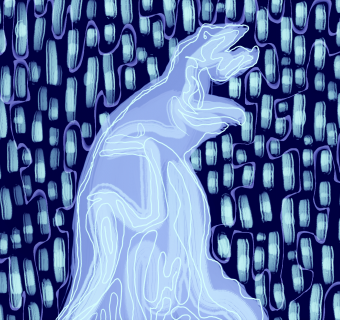
An immortal dog shook her tail and bathed in an Indian Country river when the great-grandson of the Town Destroyer ambushed Jumonville Glen. “Come away, India,” called her Shawnee master from the shore, “before the long knives come through here again.” Obediently, the large greyhound waded from the shallow water and followed after the man. A stuffed foot swung from his belt. India knew it belonged to her predecessor, a village dog who had died long ago with the others when the Europeans arrived. Her master tossed down a square of red game, and when she swallowed, he prophesied wryly, “Maybe they will take you. Mayhaps they will know the truth of what you are.”
Instinctually, a white electricity jolted through her like lightning; her blood was theirs.
Fate: a shot from steel exploded through the air, right in the Ohio forest, from behind a copse of trees. Smoke billowed from a bayonet, and India watched as her master planted his feet around to face the two pink-flushed faces in the underbrush, cocking his rifle. Instinctually, a white electricity jolted through her like lightning; her blood was theirs.
“Damn,” a voice hissed, in an abstract tongue she recalled from when she was a mere pup, huddled at her mother’s nipple in a Yorkshire basket, “missed it.”
“Well, the less, the merrier,” the other spoke quietly, in a different brogue. “The country is rife with tension. How far does this go?”
“Oh, I would say up to the Line… look, a bitch. One of ours?”
“You must not blame us… whatever the king ‘proclaims’, all of this land is meant to be devoured,"
“Yes, but ‘tis nothing compared to a panther. Stay there, I will talk to him.” A long shadow emerged from behind a tree, solid and slender in form, and smiled winsomely at her master. “Sorry for that,” he apologized, palms up. “How much for the dog?”
“One of your sort sold her to me.” Her owner’s tone was ice, as he lowered his rifle a notch. “When you came here. This part is our country. Your king said so.”
“You must not blame us… whatever the king ‘proclaims’, all of this land is meant to be devoured,” the interloper said casually. “Things are changing, you cannot deny that. So, how much for her?”
“If you want her, you can have her. But let me tell you one thing,” her master warned, fingering the purple-and-white wampum beads around his neck. “She is not from this country. She is from yours. A witch made this creature.”
“This country is my country. How much for her?”
Things were changing; the days of Plymouth rocks and Jamestown swamps, in which she scampered on and swam in, were gone.
Daniel Boone paid five Pennsylvania shillings and ten wampum beads for India, but quickly traded her for worthier pursuits, as he conquered the frontier; she moved from backwoodsman to maligned settler, until she slept in a loghouse on the Proclamation Line. A shame, she thought, that all that country past the border would be used for what those foreigners manifested into life. Boone was right. Things were changing; the days of Plymouth rocks and Jamestown swamps, in which she scampered on and swam in, were gone. A war had set fire to it all, a war that would engulf the East Coast. Her first master was long dead from the skirmishes when General Washington gifted India to Lieutenant General Cornwallis, as a sign of goodwill. That goodwill was placed on a ship to Delhi when there was no use for her amongst the sleek hunting-dogs.
A harlequin city, Delhi was. As the jewel of the crown dulled underneath the ironfist of the British, the fitful decades blended together until India discovered an immortal yellow pariah, sleeping underneath the roof of a once-Kashmiri lawyer as his watchdog. “How strange you are!” she mused, when she learned his name was London.
“How strange you are,” he responded dryly, cracking open a small, obsidian eye and rising onto his hindlegs. “What sort of name is India? Some might say you are trying to seem true.”
At least, that was what she wished to bark. Instead, her hackles flared up—and before she knew it, she lunged at him...
“You are one to talk, London-saab. ‘Tis a joke.” The two trotted to the edge of the main street, where a procession passed through, tricolor flags rippling in the air. “My first master gave it to me.”
“You yoked yourself to a master? Willingly?”
Not willingly. Never willingly. At least, that was what she wished to bark. Instead, her hackles flared up—and before she knew it, she lunged at him, and he shot into the crush of bodies all fluidly adjoined like a singular patriotic limb; his scent of hard earth vanished, replaced by the tangy musk of a man. Firm legs came into her view, London crouched behind his owner protectively. India uncomfortably glanced up to see a gentleman in a khadi sidecap peering down at her. “Well,” he breathed in accented Urdu, picking her up, “what a pretty thing you are. No fleas, nor no lameness… I shall take you home. Come, celebrate—it is our independence day.”
Somewhere, down the road, from a radio trickled the speech the Prime Minister had delivered the night before, about a tryst with destiny.
“Hindustan zindabad,” the poor and the rich, the young and the old, cheered in an outpouring of triumph. Long live India, the sentiment prevailed, arcing through the roots of the city. Somewhere, down the road, from a radio trickled the speech the Prime Minister had delivered the night before, about a tryst with destiny. Jawaharlal Nehru smiled, listening to his own voice. He wove through the mass to cross over into an immaculate house, windows flung open and curtains fluttering. He set the greyhound down by a door, and entered the room. India trotted along, London lagging behind; the Radcliffe Line sat, ugly as a newborn babe, across the map.
The beleaguered British officers withdrew from their weeks of hasty work, leaving the continent sitting on the dining table for Lord Mountbatten to deliver to Nehru and Jinnah in privacy. So harried the trio were, that Mountbatten tripped over their tails as he exited. “What’s that beast’s name?” he demanded.
“That yellow one is London; the other is new,” Nehru replied in his crisp accent. “Perhaps you have a name for her?”
Leaning forward, she could smell the coppery stench of game.
The Viceroy swatted at them unthinkingly, telling London and the newly-christened Janus to scram. As their backs vanished down the corridor, Janus disobeyed; she placed her paws on the edge of the table and pushed herself up to see the Line better. A slab of meat, cut in the middle. She tilted her head. Ohio came to her mind, from all those centuries ago. The Thirteen Colonies had become an enterprise, a country on its own, she last heard, springing from an alchemist's pot bubbling in the hearth, juiced with the blood of four million slaves and more to come. Leaning forward, she could smell the coppery stench of game. Remembering the swinging foot, she bit into Hindustan and chewed it up.
London yelped from the back of his throat and scrabbled away, fleeing from the chamber. His panicked whining brought the attention of her new master, who came in to find his pretty greyhound dead on the floor. Crimson seeped from her body. The map with the Radcliffe Line ejected from her jaws, mangled and wet. Nehru knelt down to quietly pick her up, and when he clutched her in his arms, her bones gleamed. Iron, he realized.
He nosed the lid open, and tore at the brocade of her flesh with his nimble teeth, and swallowed the nettles down to his belly.
London was uncommonly obedient that afternoon, his handlers thought, idly throwing him a ball, and then quickly forgetting him to join the fanfare in the streets. They did not notice the pariah slipping through the door to the cool, dark casket Janus was laying in. He nosed the lid open, and tore at the brocade of her flesh with his nimble teeth, and swallowed the nettles down to his belly. I knew, the clever creature thought, I knew she was false.
A witch's fiction. The next day, as the British left India after two hundred years, they buried the iron bones in a shallow grave on the Punjab border, and sent the rest of the beast to be interred in Ohio. “Come along, London. Let’s leave Janus to rest,” Lord Mountbatten whistled in pity to the pariah, striding away from the tombstone.
The dog glanced back once at the split—like two heads—in between the epigraph. Goodbye, goodbye, this will end with that: his mellow adieu was swallowed by the warm winds. Then, London, with his seesucker hide, followed.
*Afterword
A twenty-one-year-old George Washington ambushed a fort in Jumonville Glen, sparking the French and Indian War in the Thirteen Colonies. His great-grandfather was called Conocatarious, or ‘destroyer of towns’ by the Indigenous people, and bestowed the same name to Washington.
‘Long knives’ is the term the Haudenosaunee and other Indigenous tribes of the Ohio territory gave the white settlers. The ‘panther’ line is a reference to a myth of Boone shooting a panther.
The Proclamation Line of 1763 by George III was drawn to keep colonial settlers from the Ohio territory beyond the Colonies, but that was quickly disregarded by Americans.
Dogs indigenous to America died out due to the diseases the Europeans brought over. Pariahs are dogs native to India that were pushed aside in favor of European dogs.
While not entirely native to England, the greyhound dog has a long cultural history there.
Brocade is a European cloth that marked the European elite, and soon was used in South Asia; seersucker is a fabric that originated in colonial India and soon became common in the West.
Indian independence was achieved in 1947, quickly followed by Partition, divided by the Radcliffe Line. Millions of lives were upended and destroyed; violence erupted in major cities.
Nehru, born in Kashmir and a lawyer before becoming a politician, famously loved pets. Lord Mountbatten was the Viceroy of India and oversaw the transition of power. India (the dog) and London (the dog) did not exist; this is just artistic license.