Bern takes his cedar rowboat out on the lake like any morning. The sunrise spills out over the water like a knife wound. He baits his hook and casts into the deep.
Sudden motion on the treeline catches his eye—a small flash of red through the green. The rustle of branches carries across the lake. And then there is a tug on his line.
A silvery trout spasms to the surface, and he slides it from the steel hook. “Do you know today is the last day of the world?” He watches its flat pupil as it convulses against his palms. “Does it make any difference to you?”
The hoarse sound of his voice is alien to him. The last time he spoke was to greet the mail carrier delivering his medical bills last week. She hadn’t even heard him.
A young girl’s laughter rings out from the woods. It sounds so much like Margarethe that he must have imagined it. Sometimes he tells himself that that girl entered the world already leaving, but he knows it’s his fault he could not hold on.
She was born a month early in a freak hailstorm. He remembers the softball-sized stone that went right through his windshield as he sped home from the ranger station. When he found Therese, she was cutting the umbilical cord with her teeth. The floor was slick with blood.
“My radio was dead,” he said stupidly.
“She’s not crying, Bern.” That silence is still the worst sound he has ever heard. He took his daughter in his arms and held her close to the warmth of his chest. She was so fragile; when she began to twitch, it was like a butterfly taking off. And then she began to cry, louder than anything. He would bottle that wail if he could. He was grateful for every day she was loud after that.
She was loud when she turned her shoebox bedroom into an oil studio and had heated conversations with her paintings. Late into the night, she would demand of her canvases, What do you want? She was loud at her mother’s funeral, where she climbed up on the casket and shouted the words to Therese’s favorite song: I found a dream that I could speak to, a dream that I could call my own…. She was loud when she marched out of art school with her deconstructed-washing-machine sculpture of a woman, yelling, You insipid blowhards wouldn’t know art if it snogged your wife in front of you! I’m not expelled! I quit!
After that, she drifted around Europe with a gaggle of bohemians and returned with a cross-eyed one-year-old. “We call her Chella. She likes TV static and the smell of coffee.” She was hazy on the details—something about a long train ride through France and a man with eyes like a beagle puppy.
In that time, she painted like it was a fever she could not shake. She would argue with her canvases late into the night and then sob to them: I’m sorry, sorry, sorry. She would hand Bern the little girl and leave for months at a time, for gallery showings and residencies.
He tried his best with Chella, but he had never really learned how to raise a little girl. She always wanted her mother, and she could not bear that her mother did not want her.
He thought Margarethe would settle down when she bought that big, awful house and filled it with her work, and she did, for a time. She was pregnant again, and she promised him that she was going to raise the boy herself. “We’ll be a real family,” she told him. “I can be a mother.”
One night, he saw her drifting down the hall, limned by moonlight and talking to the walls: You have to let me go. You can't keep me.
For years, she went through the motions to take care of her children, but she always looked at them like she did not know them. Her loudness left by degrees, so it was hard to notice it going until she was little more than a ghost, so thin and gray.
One night, he saw her drifting down the hall, limned by moonlight and talking to the walls: You have to let me go. You can’t keep me. That was the last time he saw his daughter. There was a boat and a storm and then a daughter-shaped space that was more real than before.
The sudden stillness in his hands jolts him back to the lake. The trout’s pink mouth hangs open. The first sob catches at the back of his throat, but the second one tears him apart. “I’m sorry, sorry, sorry.”
—
Monday rolls the Ford to a stop with Jude, her teased honey-blonde updo perfectly framed through the windshield. Pretty Boy Floyd’s “I Wanna Be With You” cuts off mid-belt. She leaps out of the truck and flings her arms around Jude, crushing her bouquet of sunflowers. She smells like mouthwash and fresh summer dirt.
Jude is smiling around her crooked front teeth like she can’t help it. “How did you steal your father’s truck? Doesn’t he sleep with the keys?”
“Hotwire,” Monday flashes a grin. “Did you steal those from Byrne’s field?”
“Yeah.” Jude ducks her head. “They’re for Duncan.”
Monday reconsiders the rumpled clutch of yellow flowers. “Thank you,” she says. “He would—will love them.” She lifts the gear bag from beside Jude and slings it around her shoulder. “Are you ready?”
“As I’ll ever be,” Jude says.
Monday makes quick work of the nailed boards at the mouth of the old tunnels with the back of a rusty hammer. The county had not put much effort into the barrier because the events of last summer were enough to scare most errant teens away. She stares at the darkness for a moment before clicking on her headlamp and stepping in.
“I know why you had to move, but I really, really missed you,” Jude says, nudging her from behind.
“Well, I missed you more.”
“Not possible.” Jude waits a beat before asking, “Did you tell Sabine where we’re going?”
“No,” Monday says flatly. “We haven’t spoken since the wake. She was never into the ghost-hunting thing, anyway.”
“Can’t we call it spirit scavenging or something? Hunting sounds so mean.” Jude scuffs her boot against the ground, sending up a cloud of dirt. “I just thought she might want to know we’re returning to the place where…”
“Where she led my brother to his death?”
“Mon, that’s not fair. She couldn’t have known.”
“I told her what would happen, and she just had to drag him underground anyway.” The rescuers found Sabine 20 hours after the collapse. They hadn’t found Duncan at all.
Monday never really believed in ghosts. And then her brother died, and she did—because he had to be somewhere, because someone that alive couldn't just go.
The rest of the walk to the cave-in passes in silence. Monday can’t stop thinking: he’s here. This place is her brother now.
Monday casts a glance back at Jude and pulls the spirit box from the duffel. Ghost-hunting started as a game for the four of them. Duncan was a scaredy cat, and it was fun to watch him squirm. Monday never really believed in ghosts. And then her brother died, and she did—because he had to be somewhere, because someone that alive couldn’t just go.
She switches on the box and clears her throat. “Duncan, it’s Monday and Jude. Give us a sign you’re here.”
The spirit box spews its usual train of drivel: “Gun— south— born— grace— uh— was— blue— stop— left.” She bangs the box against her palm and lifts it closer to the dirt wall that holds her brother’s body. “Break— knot— red— bird— eh— crime—”
Jude lays a hand on her arm. “Why don’t you try saying something else? What would you say to him if he were here?”
Monday swallows. “Duncan, I… I never stopped looking for you. I look for you on the bottom bunk, pulling that spaceship duvet over your head well past noon on a Saturday. I look for your red bike crashing into the neighbor’s mailbox. I even still check the Galaga machine at the diner to see if you one-upped my high score again. It just never made sense that you’re gone. You took all the sun with you when you left. And now, it feels right that the world is ending, because how could it keep turning without—” Her voice wavers, and Jude squeezes her arm.
“I’m sorry, Duncan. I’m sorry for stealing your baseball cards and for that time I ratted you out for sneaking to Sabine’s pool party. I’m sorry the obituary called you upstanding and God-fearing. We all know it’s God who should fear you.
“I’m sorry that I yelled at you that night, and I’m more sorry that you didn’t listen. I’m sorry the last word I said to you was bonehead.” She swipes a hand across her cheeks. “I’m sorry you died scared, and I wasn’t there to hold your hand.”
The spirit box says, “Tuesday.”
The girls look at each other with wide eyes. “Duncan?”
“Honest— some— reach— live— live— run—”
And then the ground gives way beneath their feet. Jude lands with her elbow on Monday’s ribcage, and all the breath goes out of her. They both hack up dust as Jude pulls her to her feet.
“At least we didn’t fall far. Look—there’s still a way through here. Do you think this is where they rescued Sabine?”
Jude begins to walk on, but Monday grabs her arm. “Let’s just stop, okay?” She sits down, hard. “We’re going to die down here anyway. Nothing matters when the world is ending.”
Jude squats beside her and lifts her hands with fingers outstretched like she can see the stars. “Or everything matters because the world is ending.”
"No, really. Like, that laugh matters. I think Copernicus got it all wrong. The world revolves around that laugh."
“Oh God, you sound so cliché,” Monday laughs.
“No, really. Like, that laugh matters. I think Copernicus got it all wrong. The world revolves around that laugh.” Monday snorts, and Jude puts a hand over her mouth. Her palm is rough with dirt but still so warm. “If I got to remake the universe tomorrow, I’d put that laugh at the center of everything.”
“When did you turn into a Hallmark movie?” Monday asks from between the other girl’s fingers. Jude flicks her temple and then tangles her fingers into Monday’s hair. Then, because nothing matters—or because everything does—Monday leans in to kiss Jude. For a moment, the world narrows to the warmth of their tongues. Aliveness is a place on the roof of Jude’s mouth. She pulls away and tucks a lock of hair behind Jude’s ear.
“I think I have wanted to do that for a long, long time,” Monday says.
“Well, I’ve wanted to do it for longer.”
“Not. Possible.” She punctuates each word with a kiss on Jude’s cheek.
Jude laughs, then goes still and cocks her head toward the opening. “Do you hear that? It sounds like… the ‘Monster Mash.’”
—
Oskar feels daylight on his skin for the first time in 14 years. It itches. He holds up a hand to shade his eyes but still has to squint at the old corner store.
Inside, the shelves are nearly empty, and no one mans the counter. He rips open a packet of dried apricots with his teeth and pours some into his mouth. And then there is a sudden weight at his elbow. A tiny woman hangs off his arm, blinking up at him like a lost dog. “Please,” she says. “You have to help me.”
He is keenly aware that this is the first time anyone has touched him in 12 years. He shakes her off anyway. “With what?”
“Help me find my daughter, please.” The woman rubs her hands down her dress, more as a nervous compulsion than an effort to smooth it. “She ran away, and we just moved here, so I don’t know where to look. She’s too young to understand what’s happening tonight.”
He looks for a good excuse to deny the woman but draws a blank. “I guess I don’t have anything better to do.”
She twitches as if to hug him but thinks better of it. “Thank you. Thank you.”
Oskar follows the strange woman out of the store. “Where did you last see her?”
“10 Riverview. Do you know it?”
“Yes, I grew up there,” he says, but the words ring hollow against what that house really was for him. It was the place he fell through the roof while trying to patch a leak his mother could not afford repairs for. She chided him while picking splinters from his arms: “Anything that can hurt you, will." It was the place she taught him to triple-lock doors and stockpile dry goods. And it was the place he received the phone call that there had been an accident, that she was never coming home again.
Oblivious to his tone, the woman continues. “See, I was packing a picnic, and she climbed out her bedroom window. You know how kids are these days.”
“Not really. I’ve been living underground for almost 15 years.”
She squawks with laughter until she realizes he is not joking. He doesn’t mind. It feels good to make someone laugh. “How come?”
“I was afraid that something bad would happen.”
“Like what?”
“Like the end of the world.” That startles another laugh out of her, and Oskar feels himself smiling.
“But now that it's real, you’re not afraid?”
“I’m terrified. But if I know I’m going to die, I may as well see the sun again first.”
“It’s okay,” she says, looking up at the sky. “I’m scared, too.”
They arrive outside the squat, brown shotgun house on Riverview. His mother is only a fog now, as are the listless months that took shape in her absence.
He remembers one day most clearly: when a woman in an oversized forest ranger uniform pried open his front window with a crowbar and tumbled inside. She had hair like a thorn bush and paint-stained hands. She looked at him with saucer eyes, like he was the intruder. “Oh,” she said. “I thought this house was abandoned.”
Oskar stared at her for a long moment, like she might disappear on her own, an afterimage. “It is.”
She cocked her head and narrowed her eyes. “Are you a ghost, then?”
Hot pink flip flops and tangerine toenails peaked out from under her brown slacks. “Almost,” he said.
“You have nice eyes for a ghost. Let me paint them sometime.” It wasn’t a question, but he nodded anyway.
He didn’t see her again for so long that he decided he had dreamed her. And then she appeared on his stoop in a thunderstorm with some oils and jars of candied apricots and cheese puffs. Every few months, she would turn up with a canvas and a story about where she had been.
Each time she left, he convinced himself that would be the last time he ever saw her. But when she found the eviction notice on his counter, she invited him to move into her basement.
He hadn’t realized how his loneliness had become a physical weight in his chest until it began to lift. Each time she left, he convinced himself that would be the last time he ever saw her. But when she found the eviction notice on his counter, she invited him to move into her basement.
A rustling in the bushes jostles Oskar from his thoughts. “Do you hear that?”
“Ladybug?” the woman asks, and it strikes him as nonsense until he realizes it must be her daughter’s name.
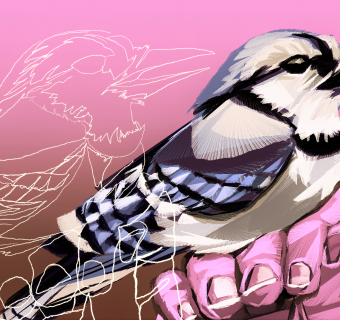
A gray cat leaps from the boxwoods and spits a young bluebird at their feet. The woman kneels to cradle it in her hands.
“My daughter’s favorite bird. She used to call them boo-bids.” She runs a thumb through the poor creature’s feathers.
“She’s barely bleeding, but she has no heartbeat.”
“You shouldn’t touch that,” Oskar says without thinking. “They carry a lot of pathogens.”
The woman smiles up at him. “What’s the worst that can happen? I die?” Then, she places her mouth around the bird’s beak and puffs five short breaths. She puts a single finger to the bird’s sternum and pushes a rhythm against it. She breathes again, then presses, breathes, presses, breathes. It’s like she’s casting a spell. Even the cat stands still, transfixed. All at once, he remembers the movements of Margarethe’s hands as she painted.
“I’m Oskar,” he blurts.
“Melody,” she says. The bird’s eye opens.
—
Sabine has never seen a dead body before tonight. Well, she saw a Cro-Magnon skeleton on a sixth-grade field trip to a natural history museum. She had pressed her hands to the glass to see the cracks in the skull, but Duncan had covered his eyes and said, “Isn’t it creepy how much it looks like us?”
And she shared that collapsed tunnel with death, but she never saw more than darkness. She only heard those distant sobs, so faint she might have hallucinated them.
She has never faced death like this, this mosaic of decay: some bodies with mortician’s rouge still on their cheeks, some sunken with black rot, some with only strings of flesh and fabric hanging off bones. The mini excavator rumbles as it unleashes another coffin from the earth. Ian Curtis drones from the boom box, In the shadowplay, acting out your own death, knowing no more….
Marco dances around the bonfire with half of his grandmother’s ribcage. Jeanie attempts a waltz with her grey great aunt, and John conducts her with a femur. Elia lies down with her head on her mother’s chest, like she can still hear a heartbeat. Peter carries his little sister around the cemetery, telling her everything that she has missed since she left.
Sabine dodges a wild swing of the bone baton to grab another drink. The bottle has a notch that nicks her lip, and the blood mixes with the beer in her mouth. Avram appears behind her to loop an arm around her waist, pulling her in. Their hips knock together, and he nuzzles against her cheek.
His eyes twinkle in the firelight. "Who has time for that? The world is ending."
She wrinkles her nose. “How do you manage to be the worst-smelling one at a party of the dead? When was the last time you showered?”
His eyes twinkle in the firelight. “Who has time for that? The world is ending.”
“And yet, Baby had time to steal that news van.” Near the fence, Baby stands topless on the van’s roof, leaning against the satellite dish and slurring the words to the “Monster Mash” through a megaphone.
“Maybe it was on her bucket list,” Avram shrugs. “Are you sure you don’t want to take the excavator to the tunnels?”
Sabine nods. Before she started taking sleeping pills, she dreamed of clawing through the rubble for Duncan every night. But, as much as she dug, she never got closer to the source of that awful whimpering. The dust and dirt just filled her mouth. Sometimes, she woke up choking on her pillow and reminding herself that, on the night it really happened, she hadn’t had the strength to dig at all. “Are you ready to see your mom?”
He does not follow her gaze to the newest open grave. “If you open the lid.” She swallows her no when she sees the look on his face.
She can feel her heartbeat in her eardrums as soon as she lowers herself into the grave. She looks up at Avram, haloed in orange light against the pitch sky, and then she opens the steel lid. There is nothing inside: no bones, no fermentation, no maggots. The padding is pristine.
When she turns around, Avram is gone. She leverages herself out of the grave and chases after him. “Avram, wait.” She hauls him to a stop. “You were only six. They probably thought you wouldn’t understand.”
“But they never told me anything about her. Grandpa won’t talk about any of it.” He looks rangy and wild in the shifting shadows of the bonfire. “I didn’t even know my own mother’s first name until I dug up a newspaper clipping when I was 10. Well, I’m done caring. Fuck her.”
Sabine considers him for a moment, and then she grabs two roman candles and a jug of gasoline. “I know something that might make you feel better.”
Avram grins and scoops up two jugs and an armful of fireworks. “I’ll race you,” he says and takes off barefoot across the grass. She cackles and takes off after him.
"Oh," she gasps. "This is so you. Of course you two would be here."
The rescue site stops her in her tracks. Somehow, she had forgotten it was here. She had erased this entire geography from her mind. “You go on ahead,” she shouts. “I want to check something first.” Avram whoops and does not look back.
Leaping the fence is easy, but she falters before approaching the hole. “Duncan, I don’t know what to say—”
“Sabine?” the hole asks.
Sabine’s jaw goes slack. She rushes to the edge of the pit, and two filthy faces peer up at her, like hatchlings from a nest.
She tries to say something, but a laugh steals her breath. It starts as a huff of disbelief and snowballs into breathless hysterics. “Oh,” she gasps. “This is so you. Of course you two would be here.”
Tears run clear through the dust on Monday’s face, but she doesn’t look sad or scared. She looks like she has been lit from the inside. “It’s been a while, Sabine.”
It takes Sabine a moment to remind her body that nothing about this is funny. She clears her throat. “I know it’s too late for this, but I’m sorry, Monday.”
“For what?”
“Everything, I guess.”
Monday sighs. “Me, too. Now get us out of here, please.”
Sabine crouches and reaches down her hand. Ahead, the first candle explodes.
—
Chella needs to find a painting that does not exist. She saw it only once, when she was little: a sweeping tableau of bright blue mares—blue like a slap on the face. The horses’ legs twist together until it is impossible to discern which limbs are whose. The final mare opens its mouth in terror, and inside is the face of a little girl—Chella.
She dreams of the painting sometimes, but it is always a little different. One night, the painting’s sky was made of fish: little glittering scales everywhere. Last night, the horses’ eyes were all closed, covered by small silver coins.
But no one else has ever seen the painting. None of the galleries have a record of a parade of blue mares, and Grandfather maintains that Mother never painted the faces of anyone she knew, even her own.
Which means the painting must be hidden somewhere deep in the house, where she has not set foot for 12 years.
Chella takes a swig of cheap vodka, and then another, and then a third just to be safe. On her way out the door, she sidesteps the glass shards from earlier, when David came by with the divorce papers.
“Really?” she asked him. “You want to do this today?”
“I don’t want to die married to you,” he said.
She threw a whiskey decanter at his feet, and then she sighed and scratched her name onto the thin black line.
Now, she wobbles up the street to the terrible, lopsided house. The front door is ajar. Longing and revulsion twist into one spear in her gut, and she nearly loses her stomach before stumbling inside.
She has never gotten used to the swooping vertigo of coming home. Paintings cover every inch of wall so that each hallway is a tunnel of ochre and cadmium, burnt sienna and phthalo green, cobalt and ultramarine. There are paintings piled in corners and nailed to ceilings, and charcoal sketches stuck to every window, muddying the light. She loses the battle with her stomach all over a landscape of a flooded graveyard.
She stands and runs her hands along the walls, the soft ridges of layered oil. Grandpa used to tell her not to touch the artwork, but Mother always hushed him.
She wiles her last day away surveying the house for blue mares. She finds paintings of children that grow from the ground like ferns and of women with translucent skin wading through water in diaphanous silks, their reflections oddly feline. She finds paintings of peacocks with soft, blue women for feathers and of men praying in a garden of whale mouths. There are no horses and no daughters.
She only knew it was not a dream because her mother smelled so strongly of wine. Mother looked at the ceiling and said, "Promise me you'll never become a mother."
Chella asked her mother about the painting only once, the night her mother shook her awake and crawled into bed beside her. She only knew it was not a dream because her mother reeked so strongly of wine.
Mother looked at the ceiling and said, “Promise me you’ll never become a mother.”
Chella was so happy to see her, it didn’t occur to say anything but yes, yes, of course. Chella still remembers the shape of that smile, one of the few real smiles she ever saw on her mother’s face.
When she realized Mother was going to leave, she asked her to braid her hair. Her hands shook the entire way down the plait. When she finally stood, Chella said, “Mom, I want to see the painting of the blue horses again.”
“I never painted any blue horses, but that’s a nice idea. Good night now, Chella.”
“No, mom, I saw it. My face was in the mouth of the last horse.”
Her mother’s face hardened. “You must have dreamed it.”
But that was impossible. Chella never made beautiful things. She only made others unhappy.
When Chella crawls into the study, her right leg slips through the floor between two canvases. She dangles through an open trapdoor, over a ladder. “The horses,” Chella whispers to herself, but when she lowers herself into the room, there is only one piece of art: a plain portrait of a man with an alien face, gaunt and wide-set. At first, she thinks of her brother, but the man is too thin and old.
The rest of the room is colorless: concrete, crates of canned food, steel shelves with books on naval history and dozens of gray journals. There is a note pinned to the wall in her mother’s handwriting: “Dear O— I have to leave this place for good. I hope you will understand, but I know you won’t. I wish I could say sorry and mean it. M.” This is the last remaining artifact of her mother. She tears it to pieces.
Her phone chirps with a message from her little brother: Why didn’t you tell me they buried an empty casket?
She wants to respond, Does it matter? No matter how you tell the story, she’s gone. And she never once painted her daughter. The only Chella she left behind is this one: a drunk divorcée, a marionette with cut strings, an exit wound.
Instead, she texts, Where are you?
The smell of smoke begins to permeate the basement.
—
Ladybug is on an adventure. The kitten on her shoulder tangles its claws in her hair for balance as she tramples through the underbrush.
She found the little tabby stranded on a stone at the crook of a creek. She skinned her knees sliding down the banks to reach him. She lifted him by his scruff and held his nose to hers. “You must be on an adventure, too.”
“Mew,” the kitten said. “Mew, mew.”
“Okay, you can come with me, because you asked so nicely.”
Now, the kitten raises its head to track a bluebird through the understory. Its russet belly streaks across the patchwork of green and light.
Something soft squishes under Ladybug’s heel. The yellow meat of an overripe pawpaw sticks to the underside of her red rainboot.
“Look,” she says to the kitten, gesturing up at the branches drooping with fruit. “Mama taught me about these, how they taste like a mango ran headlong into a banana.”
She stands on her tiptoes to pluck one from a low clutch. The skin is cool and chalky against her palm, so soft that her incisors slide right through. The tabby laps up the juice that trickles down her chin.
The first pawpaw only leaves her hungrier. She brings a second to her mouth, and another, and then tucks two more into her skirt pockets before tottering on through the woods. The kitten mewls and kneads its little paws into her polka dot sweater.
Dusk falls around them all at once, like a candle blown out, but a new orange glow begins to bleed through the trees, a second sunset. The flickering light seems to beckon her from beyond the leaves.
Then, the bush beside her begins to hiss. A shadowy form lurches from the undergrowth, landing right on her toes. Lantern yellow eyes blink up at her.
“Oh.” She lifts the kitten from her shoulder. He squirms in the air as if trying to swim and does not look at her. “I want to say goodbye, but I know I’ll see you again soon.” The mother cat takes him by the neck and disappears into the brush.
The orange light is warm on her face now, licking across her cheeks. The faint smell of smoke fills her nostrils, woody and sharp. She walks on until she breaks through into a large clearing.
There is a hill of dying grass and a fire shaped like a house. A thick tunnel of black smoke rises to blot out stars. Several figures stand at the far edge of the dell—orange, red, and shadow dancing across their faces.
Suddenly, a reedy man bursts forth from between the flames with a woman wrapped around his shoulders. They appear shaken but miraculously unharmed. The two stumble down the crumbling steps, where another figure rushes to meet them.
“Margarethe,” a voice says behind her. She jumps and turns to see a lumpy old man hovering in the treeline.
He holds up his hands like Mama did when that raccoon snuck into the old garage. His face is a knot. “Sorry, I thought you were a ghost.”
“I’m Ladybug,” she corrects.
He arranges his mouth into something like a smile. “Nice to meet you, Ladybug. I’m Bern.”
"I was their grandfather." Ladybug cocks her head. "Was?"
She waits for him to ask what she is doing or where her parents are or whether she knows she is trespassing, like adults always do when they catch her. But his eyes drift past her to the fire, blinking but not focusing.
“Do you know those people?”
“Some of them, I suppose. I was their grandfather.”
Ladybug cocks her head. “Was?”
Bern wrings his swollen hands. “Not sure I can call myself that anymore.”
“Why not?”
“I hid. I ran away from them.”
“Oh, I’m a runaway, too. But Mama’s always happy to see me again.”
He laughs once, hollow. “They don’t want to see me, I promise.”
“How do you know unless you go ask?”
He sighs. “It’s too late for that.”
Ladybug considers this. “Yeah, it’s past my bedtime, too. But they’re right there.” She offers a hand, and he just stares at it.
“C’mon.” He places a rough hand in hers and lets her tug him toward the fire.
She can see the figures more clearly as they approach. The reedy man’s wide-set eyes blink through his sooty face. The woman leans on a boy with the same alien face, a younger echo of the tall man. Three young women stand in a tangle, arms around waists and heads tucked into each other’s shoulders. From behind them, a small figure takes off running at—
“Ladybug!” Mama nearly tackles her with the force of her hug. She lifts Ladybug to rest on her hip and nuzzles into the crook of her neck, her cheeks ruddy and wet with tears. Even through all the smoke, she smells like salt and apricots.
“Where have you been, baby? I was looking for you all day.”
“I was playing in the woods, and I met a kitten, and I took him to his mother, and I found a pawpaw tree.” She pulls a fruit from her pocket, and Mama takes it with her free arm.
“Thank you, Bug,” she says. “And thank you,” she adds to the alien man.
“I didn’t do anything,” he says, bemused. “You found her all on your own.”
“I was never lost,” Ladybug insists. “I ran away, and I chose to come back.” She looks to Bern, who is staring at his grandchildren, shell-shocked. They stare back in silence.
“I’m sorry,” he says, so quietly she might have imagined it. “I don’t know what to say.”
Slowly, the woman unpeels herself from her brother’s side and tucks herself against Bern’s. “I know,” is all she says.
Two of the girls have disappeared into the treeline, but the last one puts her chin on the young man’s shoulder, linking her fingers through his.
Ladybug feels it against her chin as fresh tears fall down Mama’s face. “Don’t cry, Mama. I came back.”
“You’re right.” She tucks a lock of hair behind Ladybug’s ear. “You’re alright,” Mama says. “Everything is alright now.”
Oblivion is all the colors at once, and then nothing at all.