Dear Beloved Reader,
The end of the year is often a time for reflection. As I am finally given the space to unwind after a year of nonstop motion, I tend to find myself looking backwards, examining what I could have done better or what I wish to do differently next year. This reflection is a double-edged sword, and one that I am certainly not alone in wielding. On one hand, it may be a source of hope and anticipation for the future, which is undeniably valuable. On the other, it may create an undue sense of dissatisfaction for our own circumstances and towards our accomplishments. Worst of all, too much scrutinization over what we hope to do differently is uniquely capable of making us feel like a failure if we do not uphold our resolutions—and convinces us that the new year is the only time to change.
We all are capable of rewriting our own stories at any point. Actions, like writing, are only complete and permanent if you want them to be. Do not let the overwhelming pressure to change that accompanies the new year overwhelm you into not changing at all. Open and close doors when you are ready. If you don’t like where you currently are—at any point, not just during the new year—you are not a plant with deep roots frozen in the winter ground. You can always move to rewrite your story.
As the semester and year come to a close, I invite you to curl up under a warm blanket with a hot beverage of choice to read the final Iris issue of 2025. For this cycle, we gave our writers the prompt Rewrite, asking what they would—or wouldn’t—choose to do over if given the opportunity. Emily Frost opens our issue by completing her unfinished poem, “west pennsylvania prophecy,” juxtaposing fantastical tales with a rural, Appalachian upbringing. Similarly, CJ Ackerman-Garvin chooses to return to works left unfinished in “Untitled Document(s),” combining several fragments of writing left collecting dust in a Google Drive into one eerie short story.
Faith Leslie and Maxine Prudhomme also dabble in poetry for this issue in their pieces, “Poem in which I am” and “Extinction,” respectively, experimenting with haibun poems, or prose that, over the course of the piece, erases itself into a haiku.
Freelancer Ashley Gyawali writes of the conflict between passion and culture in her piece “Factory Flowers,” telling the story of a young couple who rewrite their love story against the backdrop of the Nepalese Civil War. Freelancer Rosie Strickland reminds us that we cannot rewrite our planet’s story once we know how it ends and urges us to tread cautiously in her poem, “An Understanding.”
Sydney McClellan reflects on the pressure she felt to choose a STEM major over the humanities and interviews a friend whose architectural studies fall within the intersection of both domains in “Arts vs. Sciences: Squashing the Beef (Once and for All!).” To close our issue just in time for the holidays, Geovanna Murphy urges us to reflect on the actions of the Whos toward the Grinch and evaluate his decision to steal Christmas with more nuance in her essay “You Guys Have the Grinch All Wrong.”
Thank you to Leigh Ann Carver, Annie Gibson, and the Social Media and Communications Team for all of their assistance even during such a busy time of year. Iris artists, thank you for always doing such incredible work in adding dimension and life to our writers’ pieces.
To Mary, Simone, and the Iris writers, thank you for such an amazing semester. You all push me to be better every day just by virtue of being your amazing selves.
And finally, to you, the reader: Happy reading, and happy holidays!
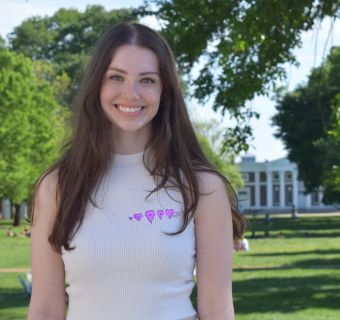
Lindsey Smith Iris Editor, 2025-2026