Dear Reader,
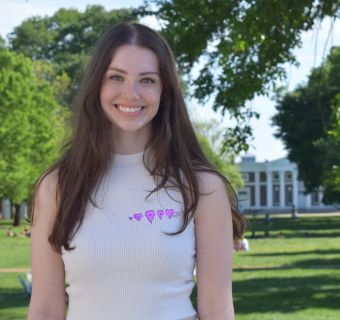
I am so thrilled that you’ve chosen to read Iris’s first issue of the 2026-27 school year. My name is Emily Frost, and after a wonderful year as a writer with Iris, I’ve become the magazine’s senior editor!
Right before the school year began, I met with editorial staff member Mary Esselman to discuss our ideas for Iris this year. She asked me what trends I was noticing on social media that could perhaps inform our work with the magazine. Immediately, I thought of all the resistance to AI I had seen lately: graduating seniors booing pro-AI commencement speakers, people comparing their own work to what ChatGPT could generate, the omnipresent “your AI slop bores me” reaction image, and so forth. As an English major who has dedicated my college experience to studying human expression, I’ve been quite relieved to see this trend.
Mary and I decided that the overarching theme for our Iris issues this semester will be Renaissance: a celebration of the wider return to prioritizing human creativity, heedless of outside forces that pressure us to outsource our critical thinking skills and the essence of what makes us human to machines. Our first issue, Alchemy, was inspired by Renaissance attempts to turn what was ordinary into what is extraordinary.
Andrea Santos opens this issue with her cento, or found poem, “Creating the Melting Pot,” where she connects the words of immigrants in the United States to stages of the alchemical process.
Monet Gonda reflects on how she learned to love her natural hair as a Black woman in her piece “wearing my natural hair healed my relationship with beauty.” Then, in her piece “Split-Ends,” Geovanna Murphy takes us through her coming-of-age journey as shown through her many hair transformations.
Reflecting on a friend’s experience in which students in their class expressed limited hopes for the future, Beck Jewell’s poem “Employed / Housed / Alive” asks us to consider what a more vibrant world could look like.
In their pieces “The Roads that Said No” and “Closed Mouths Don’t Get Fed,” respectively, Chasity Quarles and Madina Fayzieva grapple with how to keep moving in the face of rejection and uncertainty.
Ashley Gyawali’s short story “Lines and Underdogs” depicts two major historical events — the founding of the United States of America and Indian independence — from the perspective of a remarkably well-traveled immortal dog and asks us what is lost and gained as nations are born.
Sydney McClellan’s piece “My DELTARUNE Summers” reflects on how her relationship with a favorite video game has evolved as she has progressed from high school to college. Even though she doesn’t travel to alternate realities (as far as I know) like the main characters of this game, DELTARUNE has remained a source of comfort and escapism even as her life has changed.
Alyssa Rim argues on behalf of nosy kids everywhere in her piece “A Nose for News” as she tracks how the same nosiness that adults reprimanded her for as a child has led her to become an intrepid reporter. Then, CJ Ackerman-Garvin vividly portrays the relationship between a scientist and the life she has created in their short story “A Clouded Vision.”
Finally, Bridgette Stands closes this issue with her piece “We Built the Homunculus.” She introduces us to a brief history of attempts to create artificial life and argues that we must better understand our own consciousness before we address the question of whether AI is conscious—or entrust AI with any significant responsibilities.
I am so grateful for our excellent team of eleven new and returning writers. After such a strong first issue, I cannot wait to see all they create this year.
I would also like to thank my fellow Women’s Center staff members Leigh Ann Carver, Annie Gibson, and Mary Esselman. You quite literally would not be reading this issue without them — special thanks to Leigh Ann for teaching me how to load our writers’ pieces onto the website. Since Iris does not have an assistant editor this year, Mary’s assistance in editing our writers’ pieces has been invaluable.
On behalf of the whole team, I warmly welcome you to Iris’s very own Renaissance era!
Emily Frost